
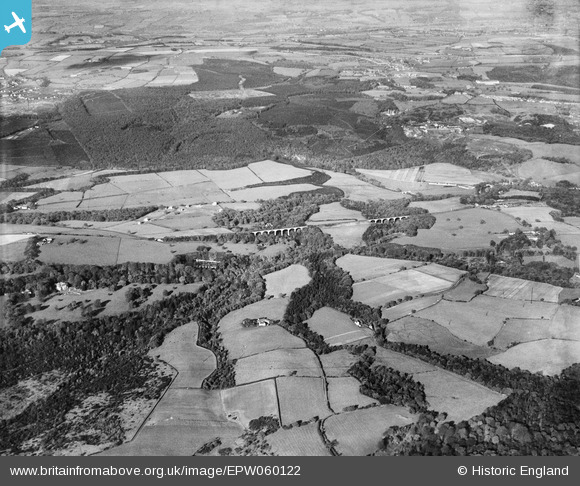
EPW060122 ENGLAND (1938). Chopwell Wood, Hamsterley Park and the surrounding countryside, Hamsterley Mill, 1938
© Hawlfraint cyfranwyr OpenStreetMap a thrwyddedwyd gan yr OpenStreetMap Foundation. 2026. Trwyddedir y gartograffeg fel CC BY-SA.
Manylion
| Pennawd | [EPW060122] Chopwell Wood, Hamsterley Park and the surrounding countryside, Hamsterley Mill, 1938 |
| Cyfeirnod | EPW060122 |
| Dyddiad | 1-November-1938 |
| Dolen | |
| Enw lle | HAMSTERLEY MILL |
| Plwyf | |
| Ardal | |
| Gwlad | ENGLAND |
| Dwyreiniad / Gogleddiad | 414584, 556319 |
| Hydred / Lledred | -1.7725486542899, 54.901298876546 |
| Cyfeirnod Grid Cenedlaethol | NZ146563 |
Pinnau
 Hookergate School was a secondary school and sixth form located in High Spen in the Metropolitan Borough of Gateshead, England.
Originally founded as Hookergate Grammar School, the secondary school was formally merged with Ryton Comprehensive School in 2011, and was renamed Charles Thorp Comprehensive School (now Thorp Academy). The new school operated over both of the former school sites until 2012 when the school relocated completely to the former Ryton school campus. The school campus went up for sale, with offers closing on 18 November 2015, to be sold as a 'development opportunity'.[1]
The site upon where the school was located had been then used for filming of BBC Children's Productions shows such as Wolfblood and a spin-off of Tracy Beaker Returns, The Dumping Ground. Hookergate School was a secondary school and sixth form located in High Spen in the Metropolitan Borough of Gateshead, England.
Originally founded as Hookergate Grammar School, the secondary school was formally merged with Ryton Comprehensive School in 2011, and was renamed Charles Thorp Comprehensive School (now Thorp Academy). The new school operated over both of the former school sites until 2012 when the school relocated completely to the former Ryton school campus. The school campus went up for sale, with offers closing on 18 November 2015, to be sold as a 'development opportunity'.[1]
The site upon where the school was located had been then used for filming of BBC Children's Productions shows such as Wolfblood and a spin-off of Tracy Beaker Returns, The Dumping Ground. |

RayU |
Friday 17th of April 2026 03:33:22 PM |
| St Patrick's Church, Hookergate. |
RayU |
Friday 17th of April 2026 03:30:16 PM |
| Victoria Garesfield. The Victoria Garesfield Colliery is situated about a mile south of Garesfield, and is working the same royalties as that colliery. At both these collieries large quantities of excellent coke is made, as well as fire brick. This colliery was opened by Thomas Ramsay in 1870, but was taken over by Messrs. A. J. Priestman and George Peel (Piele) in 1885. |
RayU |
Friday 17th of April 2026 03:08:24 PM |
| Lintz Green Railway Station was on the Derwent Valley Railway Branch of the North Eastern Railway near Consett, County Durham, England. The railway station opened with the rest of the line on 2 December 1867 and closed to passengers on the 2 November 1953. The line closed completely in 1963 and was dismantled with the station site becoming part of the Derwent Walk Country Park.
The hamlet of Lintz Green is roughly half a mile south of the station site, and the small village of Lintzford is by the River Derwent about a half-mile to the north.
The station was infamous at the time for the unsolved 1911 murder of its stationmaster. On the night of Saturday 7 October 1911 the sixty-year-old stationmaster, George Wilson, was shot when returning home after closing his office at the station. Although he did not die instantly, when questioned, Wilson was unable to say who had shot him.
The motive for the killing was probably robbery, as Wilson was in the habit of carrying the day's takings from the booking office to his house, a trip of 50 yards, when he left for the night. On the day in question, however, he had transported the money earlier in the day. Although the murder hunt, still one of the largest in the northeast, involved two hundred officers, no one was convicted of the crime.
The prime suspect was the relief porter Samuel Atkinson, who was arraigned at the local magistrates' court for the murder and sent for trial at the assize court in Durham. At the opening of the trial, the local chief constable, William E. Morant, appeared and offered no evidence against Atkinson, who was released. |
RayU |
Friday 17th of April 2026 02:52:10 PM |
| Lintzford Paper Mill, on the site of a water cornmill dating to the 14th century, but making paper possibly from 1695, certainly by 1703. It continued making paper until 1922-4 when an ink works was established on the site. Originally water, but later steam-powered. Richardson's Printing Inks was converted to residential use in 1987. The former ink works are now known as Turbine House, probably built in the 1840s, which has been partially demolished. On the northern side of the courtyard is Lintzford House, the mill owner's residence, now converted into two houses. Built in the late 18th century with 19th century additions. On the riverside behind the former ink works is a former mill, now a house. Opposite this is a terrace of workmen's cottages. The mill race, sandstone steps and a sluice, dating to 1840, survives on the southern side of the courtyard. Adjacent to the bridge are two houses, Bridge House (18th century) and Mill House (a 1989 copy). |
RayU |
Friday 17th of April 2026 02:47:36 PM |
| Hamsterley Hall is an 18th-century English country house at Hamsterley, Rowlands Gill, County Durham, England. It is a Grade II* listed building.
The estate at Hamsterley was given, in 1762, by Sir John Swinburne Baronet to his younger brother Henry Swinburne. In 1769, Henry carried out substantial alterations to the then existing house to create the present two-story, four-bayed castellated Gothic Revival-style mansion.
Swinburne died in 1803, and in 1806 the property was sold to Anthony Surtees. His son Robert Smith Surtees, a novelist, acquired the estate in 1838. He was High Sheriff of Durham in 1856. He died in 1864, leaving his estate to his daughter Eleanor, who married John Gage Prendergast Vereker, 5th Viscount Gort in 1885. Their first son John Vereker, 6th Viscount Gort VC was succeeded in 1946 by his brother Standish Vereker, 7th Viscount MC who lived at Hamsterley until his death in 1975. |
RayU |
Friday 17th of April 2026 02:43:09 PM |